$39.7M Federal Investment to Expand Freight Capacity at Tradepoint Atlantic Maryland’s congressional delegation announced almost $39.7 million in federal funding through the U.S. Maritime Administration’s Port Infrastructure Development Program to expand freight capacity at Tradepoint
Atlantic at the Port of Baltimore. The investment will support development of the Sparrows Point Container Terminal, including expansion of the container yard and upgrades to cargo-handling infrastructure, with the goal of improving efficiency, reliability, and overall Port capacity. The project is expected to increase container capacity by approximately 70 percent and generate significant economic benefits, including the creation of more than 1,000 direct longshore jobs and thousands of
additional jobs tied to Port activity. This effort reinforces the Port of Baltimore’s role as a major economic engine and strengthens its position as a competitive hub for national and global trade. |
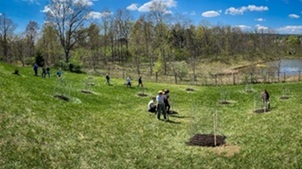
MDOT Tree Planting Grants Continue with Rolling Applications MDOT continues to offer funding through its (webpage) Urban Tree Grant Program to support tree planting efforts in communities impacted by transportation projects. Grants of up to $5,000 are available per project, with the potential for additional funding for approved pocket forest
initiatives. Applications are accepted on a rolling basis, with the upcoming planting deadline scheduled for July 15. All submissions must be completed through the (website) Maryland OneStop Portal and include approval from the appropriate County Forestry
Board. For more information or assistance with the application process, applicants can contact Nick Kurtz, Urban Tree Grant Program Coordinator, at (email) [email protected]. Purple Line Business Assistance Grants: Additional 2026 Rounds Ahead MDOT will continue offering grant funding in 2026 to assist small businesses experiencing impacts from Purple Line construction. The program is designed to help offset disruptions and support business continuity
along the corridor. Two application windows remain this year: - Round 2 due July 31, 2026
- Round 3 due November 7, 2026
Eligible businesses may apply in any of the remaining rounds. Program details, including eligibility requirements and application instructions, are available (webpage) here. Open Federal IIJA Opportunities FHWA: Roadside Pollinators Program (RPP) - This competitive grant program provides federal funding to support the implementation, enhancement,
and expansion of pollinator-friendly practices along roadsides and highway rights-of-way. Established under the Infrastructure Investment and Jobs Act, the program funds activities such as planting and seeding native grasses and wildflowers (including milkweed), implementing vegetation management strategies, and advancing habitat restoration efforts that benefit pollinator species. Eligible applicants include state DOTs, Indian Tribes, and Federal Land Management Agencies, and projects must be
tied to an existing pollinator-friendly practices plan. The program emphasizes measurable benefits to pollinator habitats, demonstrated experience with pollinator practices, and improvements that enhance the transportation environment, such as educational features or roadside beautification. For FY 2026, applications are due May 7, 2026. FTA: Ferry Programs (Passenger Ferry, Electric or Low-Emitting Ferry Pilot, and Rural Ferry Program) - This suite of competitive grant programs provides federal funding to support the improvement, expansion, and sustainability of public ferry services across urban and rural areas. The programs fund a range of activities, including capital investments such as the acquisition,
construction, rehabilitation, and modernization of ferry vessels, terminals, and supporting infrastructure, as well as planning efforts and, in rural areas, operating assistance to maintain essential service. A key focus is on enhancing system condition, reliability, and capacity, while also advancing low- and zero-emission technologies to reduce environmental impacts. Projects are evaluated based on demonstrated need, benefits to service quality and community access, consistency with local and
regional priorities, and readiness for implementation, including financial and technical capacity. Additional consideration is given to factors such as geographic diversity, safety, accessibility, and support for economic opportunity. For FY 2026, applications are due May 11, 2026. ARC: Appalachian Regional Initiative for Stronger Economies
(ARISE) - This program makes funding available on a competitive basis for multi-state projects that advance regional economic growth across the Appalachian region. Eligible activities include planning and implementation efforts related to infrastructure; workforce development; business growth; and community capacity aligned with ARC priorities. Eligible applicants include public agencies, Tribes, higher
education institutions, and nonprofits working in partnership across at least two states. Full applications (by invitation only) are due May 15, 2026. FHWA: Accelerated Innovation Deployment (AID) Demonstration - This program allocates funding on a competitive basis to support the deployment
and demonstration of innovative technologies and practices in highway transportation projects, with the goal of improving safety, accelerating project delivery, enhancing infrastructure performance, and promoting sustainability. Eligible activities span all project phases, including planning, financing, design, construction, and operations, and focus on advancing proven innovations with broad application potential. For FY 2026, applications are due May 26, 2026. USDOT: Safe Streets and Roads for All (SS4A) - This competitive grant program provides funding to support comprehensive efforts aimed at reducing roadway fatalities and serious injuries for all users, including pedestrians, bicyclists, transit riders, and motorists. The program funds a range of activities, including the development and
enhancement of safety action plans, supplemental planning and demonstration initiatives, and the implementation of projects and strategies identified through those plans. SS4A emphasizes data-driven, systemwide approaches grounded in the Safe System Approach, with a focus on improving safety outcomes, advancing equitable investments, and supporting innovative, scalable solutions across communities of varying sizes and capacities. For FY 2026, applications are due May 26,
2026. MARAD: Port Infrastructure Development Program (PIDP) - This competitive grant program provides funding to support projects that enhance the movement of goods through ports and related intermodal connections. The program focuses on improving the safety, efficiency, and reliability of freight
operations by funding a range of eligible activities, including port infrastructure upgrades, intermodal freight connections, operational improvements, and resilience measures that address environmental and climate-related risks. Eligible uses also include planning and development-phase activities, such as feasibility analyses, environmental review, and preliminary engineering, as well as investments in emissions reduction technologies and electrification infrastructure. Projects are evaluated
based on their ability to address freight mobility needs, deliver measurable economic and operational benefits, align with regional and national freight priorities, and demonstrate readiness, financial commitment, and technical capacity. Additional considerations include geographic distribution, support for opportunity zones, and incorporation of innovative technologies. For FY 2026, applications are due June 1, 2026. FRA: Consolidated Rail Infrastructure and Safety Improvements (CRISI) Program - This competitive grant program provides federal funding to advance the safety, efficiency, and reliability of intercity passenger and freight rail systems. Administered by the Federal Railroad Administration, CRISI supports a wide range of activities, including
deployment of rail safety technologies, capital improvements to infrastructure and equipment, grade crossing enhancements, congestion mitigation, rail line relocation, and multimodal connectivity projects. The program also funds workforce development, research and innovation, emissions reduction initiatives, and safety planning efforts. Projects are evaluated based on their ability to improve system performance, enhance safety outcomes, and deliver measurable operational and economic benefits,
along with considerations such as project readiness, cost effectiveness, and alignment with national transportation priorities. For FY 2025-2026, applications are due June 22, 2026. OLDCC: Defense Community Infrastructure Program (DCIP) - This competitive grant program provides federal funding to support
infrastructure projects in communities surrounding military installations, with the goal of strengthening mission readiness, enhancing military family quality of life, and improving installation resilience. Administered by the Office of Local Defense Community Cooperation, DCIP funds a range of construction-ready projects, including transportation improvements, schools, hospitals, emergency response facilities, utility systems (water, wastewater, energy, and telecommunications), and other
community support infrastructure that directly benefits military operations and personnel. Projects are evaluated based on demonstrated community-installation need, construction readiness, and alignment with priority categories such as mission assurance, family quality of life, resilience, and support for military training. Additional consideration is given to factors such as project completeness, ability to deliver within required timelines, and measurable benefits to service members and
surrounding communities. For FY 2026, proposals are due June 25, 2026. FEMA: Building Resilient Infrastructure and Communities (BRIC) - This competitive grant program provides funding to support pre-disaster hazard mitigation projects that reduce risk to communities and critical infrastructure from
natural hazards. The program prioritizes infrastructure-based solutions that deliver long-term resilience benefits, including flood risk reduction, structural mitigation, and protection of key community lifelines. Eligible activities include construction projects, as well as limited capability and capacity building efforts that support implementation. BRIC emphasizes cost-effective, technically feasible projects that are aligned with approved hazard mitigation plans and demonstrate measurable
risk reduction, with a focus on strengthening resilience for vulnerable populations and high-risk areas. For FY 2026, applications are due July 23, 2026. EDA: Public Works and Economic Adjustment Assistance Program - This program provides competitive funding to support infrastructure, workforce, and
economic recovery projects in distressed communities. Eligible activities include public works construction, broadband and utilities, workforce facilities, business incubators, revolving loan funds, and economic development planning aligned with a regional CEDS. Eligible applicants include states, local governments, Tribes, nonprofits, economic development organizations, and public-private partnerships. Applications are accepted on a rolling basis, with cost share
required. *Note: Some of these federal grants are subject to ongoing federal decisions. Please check these links for any updated
information. For more information about Open Federal Discretionary Grants, visit our webpage. |
The following links provide information on the disclosure pages for members of the House and Senate: Visit our webpage for additional resources, including: - MDOT's EV Charger Siting & Installation Partnering Form
- Uniform Grants Guidance 2024 Revision
- Clean Cities and Communities: Funding Opportunities
- USDOT IIJA
Program
- USDOT Discretionary Grants Dashboard
- BIL Launchpad
- DOT Navigator
- MDOT’s Statewide Transportation Improvement Program (STIP)
- MDOT's Transportation Resilience Improvement Plan (TRIP)
|
Did someone share this with you? Sign up to receive future issues (webpage) here! Follow MDOT on (website) X, (website) LinkedIn, and (website) Facebook! We want to support you! Reach out to discuss your capital priorities, federal funding opportunities and how we can work together.
Please visit the MDOT IIJA Federal Discretionary Grant Information webpage to learn more or to view previous newsletter editions by clicking the button below. Email [email protected] with any questions or general inquiries. |
|